Reading Time: 7 minutes
Being successful in today’s organic search requires optimizing for a variety of elements that search engines consider to be important technical, on-page, and off-page. Through the years there has been a greater interest in off-page methods like linking – and various other technical aspects.
However, the truth is that off-page SEO will not do you much good If you don’t pay attention to the basic aspects of on-page SEO. Intelligent SEO practitioners are aware that optimization on the web should always be the top priority. Since the landscape of search changes constantly, it’s crucial to ensure your knowledge of SEO on your website is up-to-date.
In this article, we will discuss the basics of on-page SEO what it is, how it works and 10 of the most crucial SEO-related considerations on the web currently.
What Is On-Page SEO?
On-page SEO (also called on-site SEO) is the process of optimizing websites to enhance a website’s SEO positions and generate organic traffic.
Alongside publishing relevant and top-quality content SEO on-page can also involve improving the HTML tags of your headline (meta tag, title, and header) as well as the images. This also includes ensuring that your site is the highest level of expertise credibility, authority, and trustworthiness.
It considers a variety of aspects of your website that, when compiled can improve your site’s ranking in the results of a search.
Why On-Page SEO Is Important?
SEO on the web is essential as it allows search engines to comprehend your site and its content, and determine whether it’s relevant to the user’s search query. As search engines get more sophisticated and sophisticated, there is a growing emphasis on semantics and relevance in search engine result webpages (SERPs).
Google with its vast array of complicated algorithms, is becoming more adept in:
- Understanding what users are looking to find when typing a search.
- Search results that are relevant to the user’s expectations (informational or shopping, navigational).
The ability to adapt to the changing trends is vital to be able to ensure that your site and its contents – both those that are visible to visitors on your pages (i.e. text videos, images, or audio) and those elements which are only visible for web crawlers (i.e., HTML tags and structured data) are optimized using the most current best practices.
Furthermore, it isn’t possible to avoid on-page SEO as you have more control over optimizing for elements on your site – unlike off-page SEO which is comprised of external signaling (i.e. backlinks, for instance). If you invest time and effort into your on-page strategies you’ll notice a rise in traffic and an increase in your online presence.
This guide will guide you through the key aspects of on-page SEO. Be attentive to these areas can help you increase the quality of your content and improve your authority, and also increase your ranking, traffic, and conversions.
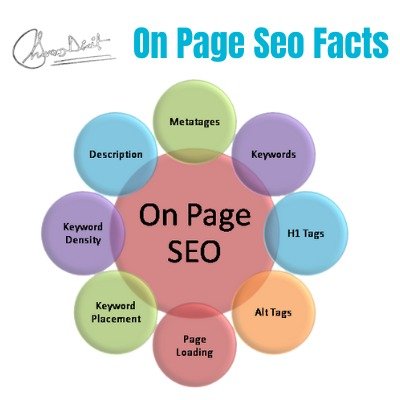
10 on-page SEO fact
1. Include keywords in your title tag
Is there something you’re first to do when looking at the SERP (Search Engine Results Page) after you type in your search phrase? You probably go through the purple titles!
Your prospects are likely to do, too. Make sure that every aspect of your page’s title is displayed exactly how you’d like it to! Google typically shows just the beginning 50-60 characters the page title in the SERP. You can either condense the title to be within the limit or If it is the case that you require a lengthy title put the most relevant keywords at the top of your title tag.
2. Wrap your headings
If two articles with the same name have keywords that are in competition and one is missing any content, Google won’t choose it to rank it first in SERP. Utilize the and heading hierarchy tags that help Google to crawl your website. It’s like providing evidence to support an argument. You’re convincing Google that you have an article that is about the subject of your title!
3. Keep URLS short
It’s easy to forget to pay attention to the text in the URLs especially because Posts automatically creates a URL using the words you typed into the title. The URLs are searched by Google and play an important role in your rank. A perfect URL doesn’t have to be as long as the name, but. Eliminate words such as “a” “the” as well as “some,” making the URL only a few key keywords, separated by hyphens. The more precise the more precise!
4. Include multimedia
Google prefers pages with longer “dwell time” as it is trying to make sure that it’s sending users to sites that people interact with and appreciate. If someone visits your site and then hits the back button in a matter of seconds, Google will record it as being a “bounce” (in another term, not a conversion). A lot of bounces and Google will conclude that your site is not what the people are searching for and may not show your website in future searches that include these keywords. The solution? Be sure that people stay at the top of your page.
Pages that feature engaging images and videos can boost time to dwell. Tips:
- Put videos on the highest point of your page so that users can see them immediately.
- It should be obvious that the videos can be played. If there isn’t a “play” button within the thumbnail, include an appropriate headline such as “Watch how our kids shine!”
- Make sure to only include information that is relevant to the content of the page. Don’t include a video that doesn’t have anything to do with the content of the page. It’s just as bad as clickbait, and it will make your visitors confused, or worse, annoyed.
A warning:
The presence of too many large images on a webpage can slow it down to load and deter people from staying on the page, which is the exact opposite of what you want! Utilize the standard file format for pictures (JPEG, PNG) and stay clear of TIFFs. Condense images and videos using compression software. If you’ve got a lot of images on the blog post, make sure you don’t make each image huge.
5. Build up a link profile
Outbound links: Outbound links tell Google what your website’s topic is about, which helps to index your site correctly. Be aware that this can allow users to leave your website, which means it is impossible to determine where they move to the next time. Make sure that the links open in a new tab.
Internal links: Linking other pages to your website improves your site’s SEO overall and increases visitors to and recognition of your other web pages. If done properly internal links can make promoting your school easier.
6. Increase word count
Longer posts (1,000plus words) are more effective than posts that are shorter in terms of search. Although Google is suspicious when your post contains keywords and your body text should contain your keyword at least once within your first 100-word post.
This is a tricky balance it’s a delicate balance. While lengthy posts are good for the algorithm, overly lengthy posts can be a source of frustration for readers. it’s not your intention to cause them to abandon your website (or even worse, not even click on your posts since you’ve earned a reputation for your witty writing!)
Find a middle way with the content of high quality that is quickly “skimmable”
- Make bullet points similar to this. Users can glance through and pick the bullets they would like to learn more about and skip ones they already know about, but it’ll still count as “reading” in the eyes of Google!
- Bold some words similar to this use italics to make it easier to draw the attention of quotes or key details and encourage users to scroll on.
7. Add alt text
Alternative text accomplishes two things. First, it helps make your site more accessible. Screen readers make use of alternative text to inform those with visual impairments what an image means. This also helps improve SEO. The description lets the algorithm correctly file and image (because Google isn’t human…yet! ). Consider it. What else can Google decide what it will show in a Google Image search? Simple:
- In the text box alternative to. Don’t overfill the box with keywords that aren’t needed there. If it’s something you can include, it’ll aid!
- Use relevant file names. “Key-differentiators-infographic.png” is more specific than “image1.png.”
8. Display social sharing buttons
Finalsite Posts shows social sharing icons at the end of each blog post to facilitate easy sharing. Because the easier it is for users to share their thoughts, the more likely it is that they will. And while it might not impact SEO in the same way, sharing frequently results in more page views, which in the long run improves your Google rank!
Make use of buttons for social sharing by:
- Encourage your teachers and staff to post their social media accounts.
- Make sure the buttons for sharing are in place in posts that showcase students or highlight individuals from the community. That’s the type of content that parents would be looking to share!
9. User Engagement
Optimizing your website’s SEO elements on the page is only one part of the battle. The other part lies in making sure that your users do not leave – instead, they’ll be able to continue looking at your content, engaging with it, and keep returning for more.
Maintaining active users is a major problem in itself, however, it’s achievable. To boost engagement among users be sure to focus on areas like site speed as well as user experience and optimization of content and many more.
10. Content Audit
The majority of content creators are so focused on creating new content and do not take the time to check the content they already have. It’s a big error.
Reviewing the content you have in place is essential because it can help you:
- Assess whether your content is meeting its objectives and earning you a return on investment.
- Determine if the information you have in your content is current or has become outdated (or even out of date).
- Discover what kinds of content are effective for you.
Content audits are a great way to improve your SEO strategy and should be performed regularly.
Conclusion
On-page SEO is essential to boost the chances that your site will show on the first page of search results. Optimizing your site for on-page factors regularly can increase your ranking in terms of traffic, conversions, and traffic.
In the short time, I’ve studied SEO patterns and best methods for marketers I’ve come across this. You could try to evade the system by making your content solely based on the algorithm. You will be successful. Simply.
But the algorithms are constantly changing when search engines become smarter. Don’t write only for them, but write in the interest of the viewers. The SEO techniques I have listed above are good practices for your readers, too.
Since that’s ultimately what web search engines want to achieve: making their users happy. Google will try to put the most relevant content in front of the correct users as fast as they can. All you have been able to accomplish is create it simple for both.